

Two months ago I gave birth to my son. He is hilarious and joyful, makes the funniest little faces while he sleeps, has a dimple in one cheek, and coos profoundly. He is, truly, like the sun. The arrival of our sun, however, was not anything like its smooth, predictable rise.
When my due date arrived with no sign of labor, my husband and I headed to The Odeon for a french fry fix. We walked home, the weather was lovely. My obstetrician had scheduled my induction for the following day – incidentally, Labor Day – but I was determined to delay it; neither baby nor I had any health issues, but she had a wedding to attend the following week and rather I be on her schedule.

A day later I had a routine sonogram, and I awoke anxious and agitated. At the end of my appointment, a reading was taken of my blood pressure. For the first time in nine months, it was elevated. Another one was done, and another, and another. Panic flickered across the nurse’s face, and she left the room to consult with the doctor, returning to tell me I needed to go to Labor and Delivery for additional monitoring. I hadn’t known that this could be a possibility, nor anticipated what would come next.
At Labor and Delivery, while I was handed a form to fill out, I began to tremble from fear and needed to sit down. Afterwards, I was moved to triage where my husband and I waited for four hours as my blood pressure rose but never settled. Some time later, my obstetrician – a woman who had attempted to scare me into thinking my baby would be enormous, and had previously insisted on an induction as, allegedly, if I was not induced, birthing would lead to extensive tearing and trauma – came by to tell me I needed to be induced. If not, she said, there was a chance I could have a stroke. Eventually I was taken to the room I would give birth in, where time began to lose all meaning.
Over this period I was prepped and primed: cervical checks; an epidural; pitocin; the insertion of a Cooper’s balloon, the heavyweight of dilation instruments. I developed a taste for orange hospital jello. Contractions came in the form of full body spasms, painless but unexpected, and I awaited the potential stroke that never came. I tried not to think about how very different my labor was looking from the one I had prepared for: no deep breathing during early labor and walks around the block; no hip squeezes my husband had practiced, which was really just my way of getting massages out of him; no records to listen to or films to watch to pass the time; the pee pads I had placed throughout the apartment in case my water broke, because when would I ever find the time to clean amniotic fluid from our sofa with a newborn; the clothes I had planned to wear to the hospital hanging in my closet. One night folded into the next, and then I was told it was time to push.
A few weeks into my third trimester, I made the decision to work with a doula. My doctor had proved herself to be unhelpful, neglecting to have important conversations around delivery, and after taking classes offered by the hospital, which placed a strange emphasis on the supposed perils of an epidural and hardly touched on the real perils of postpartum depression, I realized I had no idea what was ahead of me and needed guidance. I worked with a team of two doulas, who tasked me with writing down my preferences for when the time came to give birth.
My needs were simple, things like dim lights, no I don’t want to watch myself push in a mirror, yes I’ll take all the pain relief I can get. I made a playlist composed mainly of music by Philip Glass, Max Richter, and Brian Eno, wondering which song my son would choose to make his entrance to the world to. Now that the time had come, I felt steady and determined, eager and impatient to meet him. My husband and my doula were by my side, as well as a physician’s assistant and nurses who cheered me on. I knew I could do it, for a while. Never had I done anything harder.
The doctor who would be delivering made her rounds earlier, first insisting that I start the pitocin when I wanted to wait for my doula to arrive, mocking and undermining my desire to have her present, and then, right before I began to push, authoritatively announced that she did not want any more of the epidural to be administered to me. The problem was, shortly after the epidural had first been inserted, it needed to be flushed with saline and reset every few hours due to an issue with the equipment, and had begun to wear off.
As the time to push had approached, the atmosphere in the room was joyful. Things had not gone entirely according to plan till then, but it no longer mattered. I was in disbelief that in a short while I would be holding my son in my arms, that the moment I had been waiting for for almost two years, through infertility and surgery and IVF and heartbreak and agony, was finally here. I thought about how I had never seen my husband so enthusiastic about anything ever before, and made a mental note to tease him about it after. I felt motivated by the music. The nurses and physician’s assistant were so kind and supportive, I remember thanking them for being so wonderful between the pain of contractions and pushes.
Each time the doctor entered the room, however, the mood shifted. She was shrill and abrasive; in her presence, I could feel everyone become very tense, most of all myself. When I pushed, she criticized me, shouting that I wasn’t pushing hard enough and that I wasn’t pushing in the right place, tapping firmly on my privates to indicate where my efforts should be directed, as if I weren’t trying with all of my might. She demanded that the brightest overhead lights be turned on and held up a mirror, forcing me to look at myself crowning and subjecting me to the sight of my own excrements, something I knew very early on that I did not have the fortitude to witness. She complained that the music playing from my phone was too loud and disruptive to other patients on the floor. The more she shouted at me, the more I began to feel my energy wane. At one point I shouted back at her, I am trying, to which she responded with delight that I should get angry, and use that anger to bring my child into the world. During one of the most vulnerable moments of my life, I felt exposed and humiliated. I was in hell.
Soon I became exhausted, unable to keep my eyes open. I wanted to sleep and no longer had the strength to go on. The faces around me became increasingly unclear. Even though I was being held by my husband and my doula and was surrounded by nurses, I felt alone, as if everyone had suddenly disappeared. From somewhere far, I heard the doctor announce that I had been pushing for three and a half hours, and would now require a vacuum assist. Even though I could hear her, I couldn’t understand a word she was saying. Everything around me began to fade, and I knew I was going to die.
From what I was told by my husband: the vacuum was affixed to my son’s head, I pushed three times, and he came out quivering. He was briefly put on my chest, but not for the hour I had earlier wanted. I first exclaimed oh my god in horror, and then, he’s beautiful. There was no blissful after, no coming together as a family of three. By the time my son was delivered, my blood pressure had plummeted. Multiple people stood by me to keep me awake. The doctor pulled out my placenta as I hemorrhaged, and I sustained a third degree tear. I remember the doctor loudly declaring, amused, that this was her first third degree tear in a while. I remember wanting to kick her in the face but couldn’t, because I was certain I had died. Soon after I was stitched up and my son swaddled, my parents came in to see us. At some point, my doula walked me through how to breastfeed my son. I remember nothing.
A few hours later, a nurse came by to see if I had regained feeling in my legs. That was when I realized I was still alive. My husband was asleep in an armchair in one corner of the room, our son in his bassinet. The room seemed immense, as if a massive distance was separating me from them. After the nurse helped me clean up, we prepared to be moved to the postpartum unit. It was then, as I settled into the wheelchair, that I saw swirls of blood on the ground, and thought to myself, someone needs to mop the floor. It hadn’t occurred to me that the blood was my own.
The most enduring pain of giving birth to my son has been having no recollection of that moment, of the minutes preceding, nor of the hours after. His cry, holding him for the first time, nursing him, his face upon emerging into the world – I can recall nothing. In the weeks that followed, I was aware that there was this beautiful creature in my home and I loved him and had to protect him, but I couldn’t connect how he had come into my life. I had given birth to him yet I felt as though I had no claim to him.
Physically, I was in agony, a pain that could only be dulled with painkillers, and so severe that I could carry my son for only a few minutes at a time. The immediate postpartum period had been anything but ideal, our families failing to support us. I felt as though I was just somehow evading a darkness that would swallow me whole. Having no memory of giving birth to my son was devastating, something that enraged me and filled me with intense sadness. The guilt and shame of not experiencing a very particular vision of motherhood – joy, serenity, warmth – was consuming. I sought the support of a psychiatrist – my diagnosis was trauma and postpartum depression.
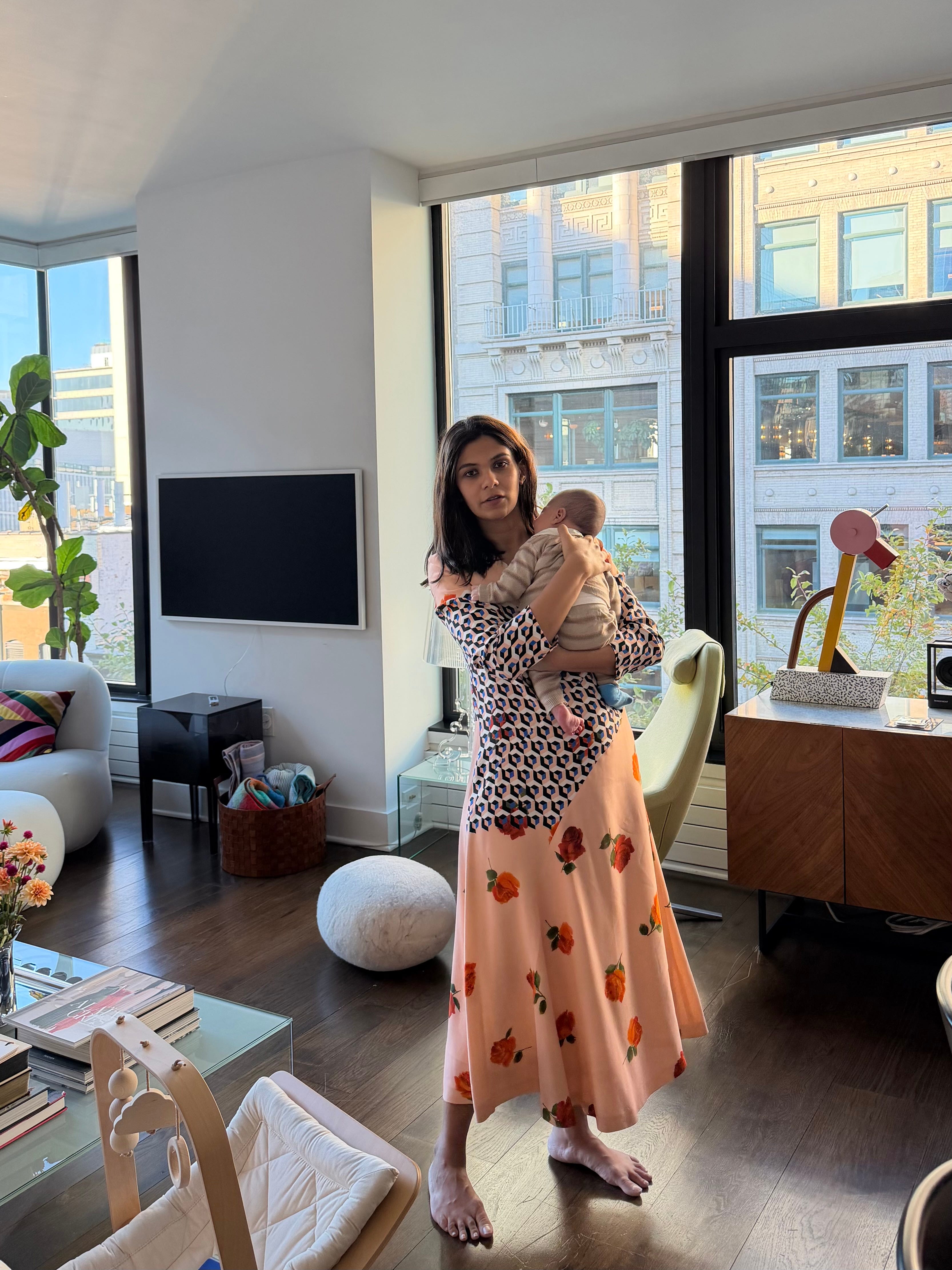
One early morning, my husband took our son out of his crib and brought him into the bed. It had been more than a month since he was born, and as I lay beside him, I realized that it was the very first time that I had done this, just being with him. In the fog of his birth and my postpartum, I found myself reflexively taking on what was required for his nurture and care, while seeking permission or surrendering him to others when it came to cuddling, playing, or laying in bed with him, just being.
Since my diagnosis and the beginning of my treatment, the fog has lifted. My son and I cuddle and play and lay about. I hear him giggle in his sleep or watch him marvel at his first balloon and am overwhelmed that he is, in fact, a part of me. When I cry now, it’s no longer from a place of grief, but rather from the incredible beauty of witnessing my son take in the world around him, of what I’ve learned from him. I still have no memory of his being born; perhaps it will come to me one day, perhaps it won’t.
My son is the love of my life. Giving birth to him broke me apart, and with him I am learning to be whole again.
no words. sending so much love in this portal-y time.
Thank you for sharing. No one can prepare you I don’t think for the birth you didn’t want. I love that you are around the bend from it. My birth too was heartbreaking and very little help in the first year. But thank god for the joyful babes. I just found a photo of me and my daughter 4 months postpartum cackling and I realize now this is what I remember the most after birth. I hate how modern medicine has turned birth into this. We are two of many women snapped and pressured and scared only for the only scary thing to be the doctor. We are about to start trying for our second and I’m trying to imagine what different care might look like from a different doctor. Thank your for your record. And I love this postpartum love and all the outfits.